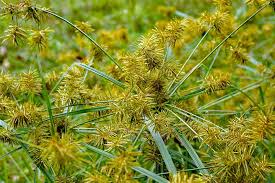
Nutsedge growing in Tampa St. Augustine lawn
Lawn Care

Nutsedge Control in Tampa Lawns: Why It Keeps Coming Back and How to Stop It

If you have been spraying your lawn for nutsedge and watching it come back thicker every time, the product is not failing. You are using the wrong chemistry entirely. Nutsedge control in Tampa fails repeatedly because yellow nutsedge (Cyperus esculentus) and purple nutsedge (Cyperus rotundus) are not weeds in the traditional sense. They are sedges with an underground tuber network that produces up to 236 tubers per plant in 8 months, and every broadleaf herbicide you spray actually makes the problem worse by eliminating the competition while leaving the sedge completely untouched. This guide gives you the correct chemistry, the right timing, and the Tampa-specific biological knowledge to stop the cycle.

When you are ready for professional help, our weed control Tampa program covers the Tampa Bay area with no contracts required.

What Is Nutsedge and Why Your Weed Killer Is Not Working

Nutsedge is not a grass and it is not a broadleaf weed. Yellow nutsedge (Cyperus esculentus) and purple nutsedge (Cyperus rotundus) belong to the Cyperaceae family, which is a completely separate plant lineage with different biochemistry than anything a standard weed killer targets. That is why nothing you spray from the garden center is working.

Here is the chemistry problem in plain terms. Most retail herbicides use auxinic chemistry, which includes products like 2,4-D, Dicamba, and MCPP. These products mimic plant growth hormones in dicots, which are broadleaf plants. Sedges are monocots with a completely different metabolic pathway. Auxinic herbicides pass through sedge tissue without triggering any response because the plant does not have the receptor the chemical is designed to hit.

Here is why your nutsedge got worse after you sprayed. A broadleaf herbicide kills the dollar weed, clover, and other broadleaf weeds competing with your nutsedge for light, water, and nutrients. The nutsedge survives untouched. With its competition gone, nutsedge expands faster into the open space. This is called competitive release and it is exactly why Tampa homeowners consistently report nutsedge exploding after they spray the wrong product.

You can confirm nutsedge in 3 seconds right now. Roll the stem between your fingers. Three flat sides confirm a sedge. A round or flat stem rules it out immediately. Sedges have edges is the fastest field identification in lawn care.

One yellow nutsedge plant produces 203 shoots and 236 tubers in 8 months. One purple nutsedge tuber produces 99 new tubers in 90 days. A single untreated plant becomes a lawn-wide infestation within one growing season. The only chemistry that works targets sedge-specific enzyme pathways, specifically ALS inhibitors like halosulfuron-methyl and PPO inhibitors like sulfentrazone.

Not sure if what you are seeing is nutsedge or something else? Four Seasons Lawn Care identifies and treats nutsedge for homeowners across the Tampa Bay area. Get My Free Lawn Analysis

How to Identify Nutsedge in Tampa St. Augustine Grass

The fastest way to confirm nutsedge is the stem test. Roll the stem between your thumb and forefinger. Three clear flat sides confirm a sedge. A round or flattened stem eliminates nutsedge from the diagnosis entirely. This single test takes 3 seconds and gets you to the correct treatment before you spend a dollar on anything.

Check the leaf base next. Sedges arrange their leaves in a 3-ranked V-shape, meaning 3 leaves emerge from each base node. Grasses use a 2-ranked arrangement. That structural difference is visible at the base of every nutsedge shoot.

Growth speed is usually what Tampa homeowners notice first. Nutsedge spikes above the St. Augustine canopy within 24 to 48 hours of mowing. That rapid regrowth comes from stored tuber energy underground, which powers explosive vertical growth while the surrounding St. Augustine recovers slowly from the cut.

On yellow nutsedge the leaf surface is glossy and reflects light visibly from standing height. St. Augustine leaves are matte. That gloss difference is one of the fastest visual confirmations available from 5 feet away.

Nutsedge grows in tight vertical clumps rather than spreading laterally like St. Augustine stolons. At the base of each clump look for the basal bulb, which is a small swollen nut-like structure at soil level that connects the shoot to the rhizome network underground.

One more structural confirmation worth knowing. Sedges carry no ligule, which is the small membrane at the junction between the leaf blade and the stem. Grasses have it. Sedges do not. If the triangular stem is hard to feel, check for the absent ligule under a magnifying glass.

Nutsedge is not crabgrass because crabgrass has a round hairy stem. It is not dallisgrass because dallisgrass has round hairy nodes. And it is not St. Augustine because Stenotaphrum secundatum spreads on flat stolons with no vertical clumping. Dollar weed is the other common Tampa lawn weed that thrives in the same wet conditions as nutsedge — for dedicated treatment of both, our professional weed control service Tampa covers the full range of Tampa Bay weed problems.

Yellow Nutsedge vs Purple Nutsedge vs Crabgrass: Tampa Identification Guide

Before you buy anything, figure out which species you are dealing with. Purple nutsedge requires more applications than yellow nutsedge and responds differently to certain active ingredients. Getting the species wrong routes you to the wrong product and costs you an extra season.

Yellow nutsedge shows glossy yellow-green leaves with long pointed tips and a spiky yellow-to-golden seed head. Purple nutsedge has darker green leaves with abrupt blunt tips and a reddish-brown seed head. Both have triangular stems that crabgrass never has.

FeatureYellow Nutsedge (Cyperus esculentus)Purple Nutsedge (Cyperus rotundus)Crabgrass
Stem shapeTriangular — 3 sidedTriangular — 3 sidedRound or flat
Leaf colorGlossy yellow-greenDark forest greenMedium green
Leaf tipLong attenuated sharp pointAbrupt blunt boat-shapedHairy blunt
Seed headSpiky yellow-to-goldenReddish-brown to dark purpleFinger-like flat spikes
Tuber architectureSingle tuber at rhizome endChains of tubers along rhizomeNo tubers — annual seed spreader
Why broadleaf herbicide failsZero sedge efficacyZero sedge efficacyZero grass efficacy — needs pre-emergent or grass-specific product

The chain architecture of purple nutsedge explains why that species feels like it multiplies after treatment. A single yellow nutsedge tuber produces one plant. A chain of purple nutsedge tubers acts like a decentralized network. Destroy the parent plant and the remaining chain nodes lie dormant or sprout one after another, with each one capable of producing a new plant. The infestation does not die with the visible shoot. It reorganizes underground.

Tampa's Zone 9b climate hosts both species. Yellow nutsedge prefers wetter conditions and is the more widespread species across the Tampa Bay area. Purple nutsedge is more drought tolerant and frequently more aggressive in the consistently warm Zone 9b climate. It does not slow down the way yellow nutsedge does in slightly cooler periods.

Why Nutsedge Keeps Coming Back: Tubers, Nutlets, and the Underground Problem

Nutsedge tuber network in Tampa soil

Nutsedge keeps coming back because tubers buried up to 18 inches in Tampa's Myakka sandy soil remain viable for more than 10 years and activate multiple new shoots within 4 to 6 weeks of the parent plant being destroyed. No surface spray can reach them.

Think of the tuber as a survival capsule. Each one is a starchy nut-like structure 0.3 to 0.75 inches in diameter with multiple dormant buds wrapped in a thick scaly outer layer. It is both the plant's energy reserve and its reproductive organ at the same time. One tuber contains everything nutsedge needs to rebuild the entire above-ground plant from scratch.

Depth is the core problem with surface sprays. Tubers form primarily in the top 6 to 10 inches of Myakka sandy soil but can reach as deep as 18 to 32 inches. A spray-on herbicide cannot reach those tubers directly. The only route to tuber-level control is a systemic herbicide that travels through the plant's own vascular system, absorbed by the leaf, translocated down through the phloem, and delivered to the rhizomes and tubers underground.

Tubers remain viable in soil for more than 10 years. A single treatment eliminates the visible plants but leaves the tuber bank completely intact, and that bank produces new shoots on its own timeline regardless of what you do above ground.

Timing is everything with nutsedge treatment. Tuber formation begins 4 to 6 weeks after the first shoot emerges. Treat before tubers form and you stop the next generation from being added to the bank. Treat after tubers mature and you have deposited thousands of new viable tubers that will survive into next season.

Nutsedge also has a biological edge over St. Augustine in Tampa's heat. Nutsedge uses C4 photosynthesis, which is a process that produces more energy at high temperatures than standard plant metabolism. At 90 to 95 degrees, which is the normal range for a Tampa Bay summer afternoon, nutsedge mobilizes its stored tuber reserves to produce several inches of vertical growth in a single day. That rebound above the St. Augustine canopy within 48 hours of mowing is not a coincidence. It is biology working exactly as designed.

St. Augustine roots, specifically Floratam stolons spreading through the top few inches of Myakka fine sand, compete for a thin slice of the soil profile. Nutsedge tubers and rhizomes pull moisture and nutrients from much deeper strata. During Tampa's periodic dry spells, nutsedge stays green and grows while the St. Augustine above it starts to stress. A thin stressed lawn from nutsedge pressure also creates entry conditions for chinch bugs. See our lawn pest control Tampa resource for how these problems compound each other.

One application never works. Killing the visible plant leaves the tuber bank intact. Surviving tubers activate within 4 to 6 weeks and the cycle restarts. Multiple applications are not optional. They are the biological minimum for any meaningful pressure reduction.

Does Pre-Emergent Stop Nutsedge: What Actually Works and What Doesn't

Standard pre-emergent herbicides have zero effect on nutsedge. No registered pre-emergent herbicide controls nutsedge spreading through tubers in lawn settings, and this misconception is the most expensive mistake in Tampa weed control.

Here is what happens when homeowners get this wrong. They apply a February or October pre-emergent, assume it covers all spring weeds including nutsedge, and skip post-emergent treatment entirely. Nutsedge tubers push through the pre-emergent barrier without any effect. The money is spent. The nutsedge is not controlled.

The reason the barrier fails comes down to biology. Pre-emergent herbicides target seeds as they germinate by creating a chemical barrier in the top inch of soil that blocks cell division. Tubers are not seeds. They are fully formed vegetative organs with their own food supply, their own dormant bud network, and their own root system. They push straight through that barrier and produce shoots above ground as if it were not there.

Sulfentrazone is a partial exception worth knowing about. Sulfentrazone-based products carry limited pre-emergent activity when applied before the first shoots appear. This reduces the first flush of visible plants and gives the following post-emergent application a smaller target population. It is not complete prevention. Surviving tubers still emerge and require post-emergent follow-up.

Your February pre-emergent stops crabgrass seeds and certain annual weeds from seed. Apply it in February for crabgrass control as planned. Then monitor for nutsedge shoots in March and April and apply a separate post-emergent nutsedge herbicide in May before tubers mature. For the complete Tampa pre-emergent timing calendar including the June and October windows, see our lawn weed treatment Tampa guide.

The Best Nutsedge Killers Safe for St. Augustine Grass in Tampa

Halosulfuron-methyl is the safest and most effective option for Tampa St. Augustine lawns. It controls both yellow and purple nutsedge systemically to the tubers at label rates with no temperature restrictions on established cultivars including Floratam and Palmetto.

Systemic chemistry is what makes this work. Contact herbicides burn the visible leaf tissue but tubers survive and resprout within weeks. A systemic herbicide absorbs through the leaf surface and travels down through the phloem, which is the plant's internal transport system, delivering the active ingredient directly to the rhizomes and tubers where it stops growth at the cellular level.

Active IngredientSt. Augustine SafetySpeed of ResultsReaches TubersTemperature Restriction
Halosulfuron-methylHigh — safe on all St. Augustine cultivars at label ratesSlow — 14 to 28 daysYes — systemic to tubersNone
ImazaquinFair — yellowing riskModerate — 10 to 14 daysModerateNone stated
SulfentrazoneModerate — discoloration above 90°FFast — 24 to 48 hoursLimited — primarily contactApply below 90°F only
BentazonModerate — discoloration riskModerate — 7 daysNo — contact onlyAvoid heat

The surfactant is the application detail most homeowners miss and it is the reason many DIY treatments fail completely. Nutsedge leaves are coated in a thick hydrophobic waxy cuticle. Spray droplets bead up and roll off the surface exactly like water on a freshly waxed car. The active ingredient never contacts living tissue. It falls to the ground and does nothing.

A non-ionic surfactant at 0.25% by volume solves this. It reduces the surface tension of the spray liquid, flattening droplets into a uniform film that sticks to the waxy leaf surface. That prolonged contact lets the active ingredient penetrate the cuticle and begin its journey down to the tubers.

Two halosulfuron-methyl formulations are available and they work differently. The concentrate version is professional-grade and treats one full acre. It requires a separate non-ionic surfactant purchase. The ready-to-mix packet version already has the surfactant incorporated in the dry powder. It treats 1,000 square feet and works well with a one-gallon spot sprayer. For most Tampa homeowners with a moderate infestation, the packet version is the simpler starting point.

Do not substitute dish soap for non-ionic surfactant. Most dish soaps are ionic. Ionic surfactants cause halosulfuron-methyl molecules to bind and fall out of solution, the herbicide degrades before it can act, and your St. Augustine risks discoloration.

The sulfentrazone heat caution is a Tampa-specific issue. Temperatures exceed 90 degrees on most summer afternoons from June through September. Apply sulfentrazone-based products before 9 AM or after 5 PM during these months. A mid-afternoon application on a 93 degree Tampa day risks temporary browning or yellowing of St. Augustine even at correct label rates.

Roundup kills nutsedge but it also kills St. Augustine. It is a non-selective herbicide and is never an option in a St. Augustine lawn.

Bentazon is contact-only, does not reach tubers, controls yellow nutsedge only, and carries a discoloration risk on St. Augustine. Do not use it as your primary nutsedge product. Use halosulfuron-methyl instead.

Every active ingredient that works on nutsedge requires 2 to 3 applications spaced 6 to 10 weeks apart in the first treatment season. Tubers that survive the first application produce new shoots. A second and third exposure targets those survivors.

When to Treat Nutsedge in Tampa: Month-by-Month Timing

Tampa Zone 9b nutsedge emerges in March when soil temperatures cross 55 degrees, which is 4 to 6 weeks ahead of inland Central Florida, and the most effective first application window is May when plants have 3 to 5 leaves and before tubers begin forming.

Tampa's maritime position in Tampa Bay accelerates spring soil warming ahead of inland Central Florida. Soil temperatures cross the 55 degree germination threshold in March in the Tampa Bay area, while inland Central Florida stations stay below this threshold until late March or early April. The same early-start advantage that drives Tampa's fertilization calendar applies to nutsedge. Monitoring begins in March, not April.

MonthNutsedge Activity in TampaYour ActionNotes
JanuaryDormantSoil test and pre-emergent planningNo nutsedge action needed
FebruaryDormant but soil warmingApply crabgrass pre-emergentDoes not control nutsedge tubers
MarchFirst tuber flush begins above 55°FMonitor for first shootsWait for 3 to 5 leaf stage before applying
AprilActive growthApply halosulfuron-methyl if shoots reach 3 to 5 leavesEarliest effective application window
MayFull active growth — tubers beginning to formApply halosulfuron-methyl with non-ionic surfactantMost critical window — prevents next tuber generation
June through SeptemberBlackout period — peak growthContinue spot treatment with halosulfuron-methyl or sulfentrazoneHerbicides not restricted by fertilizer blackout — apply sulfentrazone before 9 AM only — avoid weed and feed
OctoberTrojan Horse window — translocation beginsApply halosulfuron-methylPlant carries herbicide into tuber bank with winter food reserves
November through DecemberPlant slowsAssess results — plan year 2 applicationsNo treatment needed

The October Trojan Horse application is the most counterintuitive timing insight in nutsedge management and no Tampa competitor covers it. When soil temperatures drop in October, nutsedge moves its sugars and carbohydrates from leaves down into tubers for winter storage. Applying halosulfuron-methyl during this translocation window means the plant actively carries the herbicide into the tuber bank along with its winter food reserves. The result is a dramatically lower emergence rate the following March.

The 4-week rule governs your first application. Wait for the first flush of shoots to appear in March or April, then apply halosulfuron-methyl within 4 to 6 weeks. Applying before shoots emerge wastes the product because there is nothing above ground to absorb and translocate the herbicide. Applying after tubers mature in mid to late summer means 3 or more applications instead of 2. The May window, before tuber maturity and after 3 to 5 leaves are visible, is where 2 applications do the work of 5.

The second application targets the second flush of tubers that survived the first treatment. Apply 6 to 10 weeks after the first. The third application is the October Trojan Horse.

Will Hand-Pulling Nutsedge Make It Worse: Honest Answer

Hand-pulling nutsedge does not fix the problem and usually makes it worse. Removing the visible shoot activates dormant tubers to produce multiple new replacement shoots. Unless you dig at least 10 inches deep and 8 to 10 inches beyond the visible plant to remove every connected tuber and rhizome, you are triggering regrowth, not stopping it.

Here is why pulling backfires. When a nutsedge shoot is pulled, a disturbance signal travels down the rhizome to dormant tubers in the network below. Those tubers interpret the signal as a survival threat and activate simultaneously, each one producing multiple replacement shoots. Pulling one visible plant triggers 3 to 5 new shoots from the disturbed tuber network within 4 to 6 weeks.

Most Tampa homeowners pull nutsedge expecting an immediate fix. Six weeks later the infestation is denser than before they started.

If you insist on manual removal, follow this protocol exactly.

  • Dig at least 10 inches deep below the visible plant
  • Extend 8 to 10 inches beyond the visible plant in all directions
  • Remove every connected rhizome and tuber — missing a single tuber restarts the process
  • Attempt manual removal only for very small infestations of fewer than 5 plants — large infestations require herbicide

Mowing equipment spreads the problem too. Viable nutsedge tubers travel on mower blades from infested areas to clean areas of the same lawn and to neighboring properties. If your lawn service recently cut a neighbor's nutsedge-infested yard without cleaning equipment, their blades carry tubers directly to your lawn on the next visit. Request equipment cleaning before service if nutsedge is present anywhere in the neighborhood.

New nutsedge infestations in Tampa frequently trace back to infested fill dirt or nursery plants introduced during landscaping work. Inspect bulk soil and new plant purchases for nutsedge shoots before they enter your lawn.

How to Get Rid of Nutsedge Naturally: What Works and What Doesn't

The most effective non-chemical suppression tool you have is mowing height. Maintaining Floratam at 4 inches creates a dense canopy that blocks light from reaching the soil surface, which suppresses up to 50 percent of potential nutsedge shoots before they ever emerge. Every inch below 4 inches reduces that suppression.

Consistent mowing also drains the tuber bank over time. Each time nutsedge is mowed, the plant burns stored tuber energy to repair its leaves. Consistent mowing at the correct height reduces new tuber formation by 63 percent. Over a full growing season the bank depletes faster than new tubers accumulate, which makes chemical applications more effective and reduces the total number of applications needed. For guidance on mowing height, fertilization timing, and the full St. Augustine care calendar that supports nutsedge suppression, see our lawn fertilization program Tampa resource.

Wet spots are where nutsedge starts. Nutsedge is a hydrophytic species that evolved for wet, poorly drained soil. In Tampa lawns, nutsedge hot spots appear exactly where irrigation heads overlap, where sprinklers hit the same zone twice per cycle, or where natural drainage pools after afternoon thunderstorms. Fix the water source and nutsedge pressure in that specific spot drops dramatically within one season.

Deep infrequent watering changes the soil moisture dynamic at the surface. Water 0.5 to 0.75 inches per session once or twice per week, not 20 minutes every day. This allows the top 2 inches of Myakka sandy soil to dry between sessions. Nutsedge basal bulbs and young rhizomes live in that top 2-inch zone. Drying the surface physically stresses establishing nutsedge while established St. Augustine roots access moisture from deeper strata.

Vinegar is not a solution. It burns the visible leaf tissue but cannot reach the underground tubers. New shoots emerge from undamaged tubers within days of every application. Vinegar produces zero lasting nutsedge control and is not a substitute for selective herbicide.

Cultural practices reduce nutsedge pressure, slow tuber bank growth, and make chemical applications more effective. They do not eliminate an established infestation on their own. Combine 4-inch mowing, irrigation correction, and halosulfuron-methyl for the only approach that produces lasting results.

One Tampa-specific warning for homes near retention ponds. Nutsedge establishes at the water's edge in many Tampa Bay area neighborhoods and migrates up into the lawn. When treating nutsedge within 10 feet of a retention pond, canal, or any surface water, use only herbicides labeled for aquatic use. Most land-based sedge herbicides are toxic to aquatic life including the bluegill and largemouth bass common in Florida retention ponds.

Will Nutsedge Come Back After Treatment: Recovery and Realistic Expectations

Visible nutsedge pressure drops significantly after 2 to 3 applications of halosulfuron-methyl spaced 6 to 10 weeks apart in year 1, reduces further in year 2 as the tuber bank depletes, and approaches near elimination by year 3 with consistent treatment. But you need to go in with the right expectations from the start.

Nutsedge control is a tuber bank depletion process, not a one-and-done fix. Tampa homeowners who quit after one season because nutsedge came back slightly were given the wrong expectation about what year 1 treatment actually does.

Year 1 runs 2 to 3 applications across the treatment season. The first application kills visible plants and begins translocation to connected tubers. The second application 6 to 10 weeks later targets the second flush of tubers that survived the first treatment. The October Trojan Horse delivers a third hit to the winter tuber bank. Expect 60 to 80 percent reduction in visible nutsedge shoots after 2 applications. Not elimination. Significant visible reduction.

Year 2 requires 1 to 2 applications. The tuber bank is significantly depleted from year 1 treatment. Fewer shoots emerge in March. The April or May window arrives with a smaller target population and less volume to manage.

Year 3 approaches near elimination for most lawns. One May application plus the October Trojan Horse handles the remaining population. Some extremely persistent purple nutsedge tubers from the original bank may still produce isolated shoots that require targeted spot treatment.

Skipping year 2 is the most common setback. Surviving tubers rebuild the bank through the growing season when left untreated. By fall of the skipped year the bank is rebuilding toward year 1 levels. Quitting after year 1 restarts the clock.

Tubers remain viable in soil for more than 10 years. The bank does not deplete on its own. Consistency across multiple seasons is the only permanent path to a nutsedge-free Tampa Bay area lawn.

Professional Nutsedge Control vs DIY in Tampa

The professional advantage is surfactant calibration, May timing precision, and heat-window management that determines whether 2 or 5 applications are needed.

There are 4 things professionals do that most Tampa homeowners cannot easily replicate. They use calibrated spray equipment that delivers consistent coverage at the correct volume across the entire target area with no missed zones and no double-coverage hot spots. They mix surfactant at exactly 0.25% non-ionic by volume rather than estimating by feel. They time the May application based on soil temperature monitoring rather than a calendar date. And they apply sulfentrazone during morning windows below 90 degrees rather than mid-afternoon when a homeowner gets home from work.

The hidden cost is the sod. A homeowner who applies sulfentrazone at the wrong concentration on a 95 degree Tampa afternoon risks significant St. Augustine sod damage. One application mistake can exceed the cost of an entire professional season. Professional application eliminates that risk by using calibrated concentrations during scheduled morning windows.

DIY is acceptable when your infestation covers fewer than 20 plants, you are comfortable with surfactant mixing and volume calculation, you monitor soil temperature and apply in early morning during summer months, and you commit to 3 applications across the treatment season.

Calling a professional makes more sense when the infestation covers more than 10 percent of your lawn surface, multiple prior DIY applications failed to reduce pressure, purple nutsedge is present requiring more aggressive multi-application management, or your lawn contains a retention pond within 10 feet requiring aquatic-labeled products.

Three failed DIY applications cost more than one professional season. Four Seasons Lawn Care manages nutsedge across the Tampa Bay area with calibrated halosulfuron programs built around the Zone 9b timing window.

Frequently Asked Questions

Why does nutsedge keep coming back after I spray it?

Standard broadleaf herbicides have zero effect on sedge chemistry, and even correct sedge herbicides only kill the visible plant while underground tubers remain viable for more than 10 years and produce new shoots within 4 to 6 weeks. Control requires 2 to 3 applications of halosulfuron-methyl or sulfentrazone spaced 6 to 10 weeks apart over multiple seasons.

Is nutsedge the same as crabgrass?

Nutsedge is a sedge, not a grass. Roll the stem between your fingers — nutsedge has 3 distinct flat sides, crabgrass has a round hairy stem. Crabgrass responds to pre-emergent herbicides applied in February. Nutsedge spreads through tubers, not seeds, and no registered pre-emergent controls it.

Can I treat nutsedge during the Tampa fertilizer blackout?

Herbicides are not restricted by the summer fertilizer blackout. The blackout bans nitrogen and phosphorus fertilizers only. Apply halosulfuron-methyl or sulfentrazone throughout the June 1 through September 30 blackout period. Avoid weed and feed products that combine herbicide with fertilizer — those violate the blackout.

What kills nutsedge but not St. Augustine grass?

Halosulfuron-methyl is the safest and most effective selective option for St. Augustine grass. Always add a non-ionic surfactant — not dish soap. Sulfentrazone also controls nutsedge but restrict applications to morning hours when Tampa temperatures are below 90 degrees to avoid St. Augustine discoloration.

Does vinegar kill nutsedge?

Vinegar kills the visible leaf tissue but cannot reach the underground tubers. New shoots emerge from undamaged tubers within days of application. Vinegar provides no lasting nutsedge control. Combine irrigation correction and mowing height management with halosulfuron-methyl for the only approach that reduces the tuber bank over time.

How long does it take to get rid of nutsedge in a Tampa lawn?

Visible pressure drops significantly after 2 to 3 applications in the first treatment season. Year 2 requires fewer applications as the tuber bank depletes. Near elimination is achievable by year 3 with consistent treatment and irrigation correction. Without treatment, tubers remain viable for more than 10 years.

Your Next Step

Nutsedge keeps coming back in Tampa lawns because it is not a weed. It is a sedge with an underground tuber bank that survives every standard weed killer and rebuilds after every hand-pull. Four Seasons Lawn Care serves the Tampa Bay area with professional weed control programs that use the correct sedge chemistry, the right surfactant, and the Zone 9b timing window that separates 2 applications from 5. Get your free lawn analysis and find out how deep your tuber problem runs.

Get a free lawn analysis.
Our experts know Tampa lawns. We can identify exactly what is driving your nutsedge and build a suppression program around your specific soil and drainage conditions.